Article Overview
Unpolarized light entering a polarization-maintaining fiber splits into the fiber's two orthogonal polarization modes, resulting in an evolving elliptical polarization along the fiber rather than a preserved linear polarization.
How PM Fibers Work
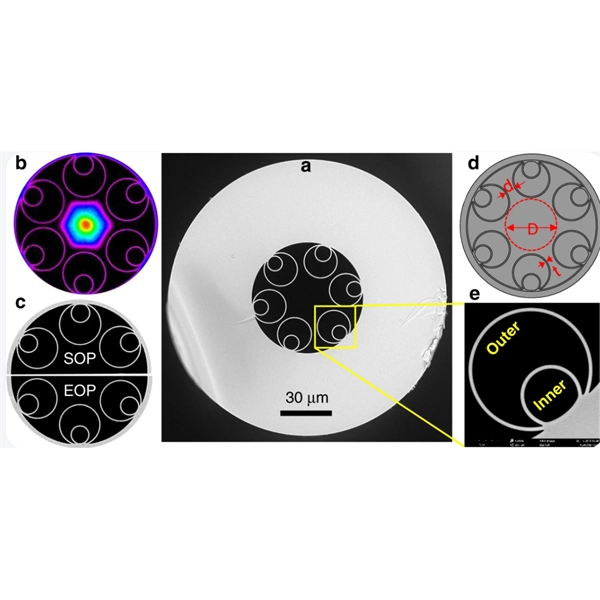
Polarization-maintaining (PM) fibers are designed with built-in birefringence, typically through stress rods or an asymmetric core, creating two orthogonal polarization axes: the fast axis and the slow axis. Light launched along one of these axes maintains its linear polarization because the two modes propagate with distinct phase velocities, minimizing cross-coupling . The beat length of the fiber defines the distance over which one mode accumulates a full wavelength phase difference relative to the other, analogous to a half-wave plate over half the beat length .
Effect of Unpolarized or Misaligned Light
When unpolarized light or linearly polarized light not aligned with the fiber axes enters a PM fiber:
- The light is effectively decomposed into components along the fast and slow axes .
- Each component propagates at a slightly different phase velocity, causing the net polarization to evolve into an elliptical state along the fiber .
- After integer multiples of the beat length, the polarization may temporarily return to a linear state, but in general, the output polarization is not the same as the input .
- For non-monochromatic light, different wavelengths experience different phase shifts, making the output polarization wavelength-dependent and more complex .
Practical Implications
- Polarization extinction ratio (PER) decreases if the input light is not aligned with the fiber axes, reducing the effectiveness of polarization-sensitive applications .
- To achieve a well-defined output polarization, it is crucial to align the input light with one of the PM fiber axes using a polarization controller or analyzer .
- In some systems, polarizing fibers (PZ fibers) are used before PM fibers to convert unpolarized light into a single polarization direction, improving stability and PER .
Summary
Unpolarized light entering a PM fiber does not maintain a fixed linear polarization. Instead, it excites both polarization modes, producing an elliptical or partially depolarized output that varies along the fiber and with wavelength. Proper alignment or pre-polarization is essential for applications requiring stable polarization. The fiber's birefringence and beat length govern the evolution of the polarization state, and environmental factors like temperature and strain can further influence the output .
Polarization of Light
Polarization refers to the electric field oscillation direction of light, with various states like linear, circular, elliptical, radial, and azimuthal.
Polarisation maintaining fiber | PPTX
It discusses the evolution and importance of polarization-maintaining fibers (PM fibers) in coherent optical transmission systems,
Transmission and Control of Polarized Light in Optical Fiber
When incident light is linearly polarized, the output light composed from two orthog-onal polarization modes is polarized light on the
Principle of polarization-maintaining optical fiber
The application of polarization-maintaining fiber can solve this problem of polarization state
Polarization-Maintaining Fiber
Polarization maintaining fiber is defined as a type of single-mode fiber that preserves the polarization state of light during propagation
What Are Polarization Maintaining Fibers?
When unpolarized light is transmitted through a polarization filter, it emerges with one-half the intensity and with vibrations in a single
Understanding the Basics of Polarization Maintaining Fiber Alignment
Precision for Optical Communication In conclusion, understanding the basics of Polarization Maintaining Fiber alignment is crucial for
What Is Polarization Maintaining Optical Fiber?
Polarization Maintaining Optical Fiber is a specialized type of single-mode fiber designed to preserve the polarization

Polarization-maintaining Fibers – PM fiber, HIBI fiber, polarization
Polarization-maintaining fibers are specialty fibers with strong built-in birefringence, preserving the linear polarization of an input beam.
Laser Polarization: A Complete Guide | Edmund Optics
The orientation of the electric field in the light wave is described by the light''s polarization. Many light sources including sunlight,
Why Do We Need Polarization Maintaining Fibers?
Conclusion Polarization-maintaining fibers are well known for their ability to allow different polarized components
A Beginner''s Guide: What Is Polarization Maintaining Fiber?
Some PM optical fibers are also used as in-line fiber polarizers because they are designed to propagate linearly
Unpolarized light
Unpolarized light is light with a random, time-varying polarization. Natural light, like most other common sources of visible light, is

Polarization Effects in Optical Fiber Links
Polarization effects are now a fundamental requirement to understand the signal propagation in modern long haul
© 2016 JETIR March 2016, Volume 3, Issue 3 (ISSN
Abstract - An optical wave made up of two perpendicular electromagnetic field constituents changing with amplitude and frequency.

Polarization-Maintaining Fibers Explained
In this article, the latest in FOC''s series covering specialty fibers and their fabrication, we discuss polarization
Polarization Maintaining Fibers | Stability, Precision & Clarity
Clarity: By eliminating the distortions associated with random polarization changes, PM fibers provide clearer signal
Polarizing Fiber Tutorial
Unpolarized light was sent into the PZ fiber, which is coiled to produce the desired effect. The PZ fiber was then spliced into a PM
Polarization-maintaining fibers
In polarization-maintaining single-mode fibers (PM fibers), the fiber symmetry is broken by integrating stress elements into the fiber
Polarization Maintaining Fibers | Tutorials on Electronics | Next
Polarization maintaining fibers (PMFs) are critical in polarization-sensitive optical coherence tomography (PS-OCT), where they
Tutorial Passive Fiber Optics, Part 9: Polarization Issues
Particularly for non-monochromatic light, a “polarization-maintaining” fiber does about the opposite of preserving the polarization
Introduction to Polarization
Light is called unpolarized if the direction of this electric field fluctuates randomly in time. Many common
Polarization-maintaining optical fiber
Polarization-maintaining fibers work by intentionally introducing a systematic linear birefringence in the fiber, so that there are two
Polarization-maintaining Fibers – PM fiber, HIBI fiber, polarization
A polarization-maintaining (PM) fiber is a specialty optical fiber designed to preserve the linear polarization of light launched into it. It
Polarization Losses in Optical Fibers
2. Polarization dynamics The representation of polarization in Jones and Stokes spaces and the connection between the two spaces

Related Resources
- Which 1U standard chassis is the best in terms of energy efficiency
- Installation of 10G Fiber Optic Ethernet Switch in Monaco
- Installation of High and Low Voltage Complete Systems in the United States
- Cloud Server AI Chip
- Tunisian cast aluminum explosion-proof distribution box model
- 288-core optical cable enters the splice box
- The switch transmits data via fiber optic cable
- Installation of QSFP28 optical transceiver module in the UAE
- How many units does a 48-core fiber optic patch panel occupy
- Upgraded Ceramic Fuse OEM Version
- Price of fiber optic cable management tools for computer rooms
- Primary Distribution Box SLD
- Ivory Coast ODF Fiber Optic Distribution Frame
- Segmented busbar wiring
- Galvanized cable tray supply in Mali
- Distribution Cabinet Busbar Company
- Price of distribution box circuits and risers
- Bridge Storage Cable Tray
- Undercurrent Relay Protection Circuit Diagram
- Grenada Fiberglass Ladder Cable Tray